

Wednesday, September 2, 2009

Friday, August 21, 2009
The Great Leech Of Tlanusi'yï
I recently had the opportunity to attempt a face-to-face encounter with the largest and most feared leech of North America.
As described by James Mooney (1891), in his accounts of the Cherokee myths and sacred formulas...
 "The spot where Valley river joins Hiwassee, at Murphy, in North Carolina, is known among the Cherokees as Tlanusi'yï, 'The Leech place,' and this is the story they tell of it:
"Just above the junction is a deep hole in Valley river, and above it is a ledge of rock running across the stream, over which people used to go as on a bridge. On the south side the trail ascended a high bank, from which they could look down into the water. One day some men going along the trail saw a great red object, full as large as a house, lying on the rock ledge in the middle of the stream below them. As they stood wondering what it could be they saw it unroll--and then they knew it was alive--and stretch itself out along the rock until it looked like a great leech with red and white stripes along its body. It rolled up into a ball and again stretched out at full length, and at last crawled down the rock and was out of sight in the deep water. The water began to boil and foam, and a great column of white spray was thrown high in the air and came down like a waterspout upon the very spot where the men had been standing,. and would have swept them all into the water but that they saw it in time and ran from the place.
"More than one person was carried down in this way, and their friends would find the body afterwards lying upon the bank with the ears and nose eaten off, until at last the people were afraid to go across the ledge any more, on account of the great leech, or even to go along that part of the trail. But there was one young fellow who laughed at the whole story, and said that he was not afraid of anything in Valley river, as he would show them. So one day he painted his face and put on his finest buckskin and started off toward the river, while all the people followed at a distance to see what might happen. Down the trail he went and out upon the ledge of rock, singing in high spirits:
Tlanu'si gäe'ga digi'gäge
Dakwa'nitlaste'stï.
I'll tie red leech skins
On my legs for garters.
"But before he was half way across the water began to boil into white foam and a great wave rose and swept over the rock and carried him down, and he was never seen again.
"Just before the Removal, sixty years ago, two women went out upon the ledge to fish. Their friends warned them of the danger, but one woman who had her baby on her back said, 'There are fish there and I'm going to have some; I'm tired of this fat meat.' She laid the child down on the rock and was preparing the line when the water suddenly rose and swept over the ledge, and would have carried off the child but that the mother ran in time to save it. The great leech is still there in the deep hole, because when people look down they see something alive moving about on the bottom, and although they can not distinguish its shape on account of the ripples on the water, yet they know it is the leech. Some say there is an underground waterway across to Nottely river, not far above the mouth, where the river bends over toward Murphy, and sometimes the leech goes over there and makes the water boil as it used to at the rock ledge. They call this spot on Nottely 'The Leech place' also.
As described by James Mooney (1891), in his accounts of the Cherokee myths and sacred formulas...
"The spot where Valley river joins Hiwassee, at Murphy, in North Carolina, is known among the Cherokees as Tlanusi'yï, 'The Leech place,' and this is the story they tell of it:"Just above the junction is a deep hole in Valley river, and above it is a ledge of rock running across the stream, over which people used to go as on a bridge. On the south side the trail ascended a high bank, from which they could look down into the water. One day some men going along the trail saw a great red object, full as large as a house, lying on the rock ledge in the middle of the stream below them. As they stood wondering what it could be they saw it unroll--and then they knew it was alive--and stretch itself out along the rock until it looked like a great leech with red and white stripes along its body. It rolled up into a ball and again stretched out at full length, and at last crawled down the rock and was out of sight in the deep water. The water began to boil and foam, and a great column of white spray was thrown high in the air and came down like a waterspout upon the very spot where the men had been standing,. and would have swept them all into the water but that they saw it in time and ran from the place.
"More than one person was carried down in this way, and their friends would find the body afterwards lying upon the bank with the ears and nose eaten off, until at last the people were afraid to go across the ledge any more, on account of the great leech, or even to go along that part of the trail. But there was one young fellow who laughed at the whole story, and said that he was not afraid of anything in Valley river, as he would show them. So one day he painted his face and put on his finest buckskin and started off toward the river, while all the people followed at a distance to see what might happen. Down the trail he went and out upon the ledge of rock, singing in high spirits:
Tlanu'si gäe'ga digi'gäge
Dakwa'nitlaste'stï.
I'll tie red leech skins
On my legs for garters.
"But before he was half way across the water began to boil into white foam and a great wave rose and swept over the rock and carried him down, and he was never seen again.
"Just before the Removal, sixty years ago, two women went out upon the ledge to fish. Their friends warned them of the danger, but one woman who had her baby on her back said, 'There are fish there and I'm going to have some; I'm tired of this fat meat.' She laid the child down on the rock and was preparing the line when the water suddenly rose and swept over the ledge, and would have carried off the child but that the mother ran in time to save it. The great leech is still there in the deep hole, because when people look down they see something alive moving about on the bottom, and although they can not distinguish its shape on account of the ripples on the water, yet they know it is the leech. Some say there is an underground waterway across to Nottely river, not far above the mouth, where the river bends over toward Murphy, and sometimes the leech goes over there and makes the water boil as it used to at the rock ledge. They call this spot on Nottely 'The Leech place' also.
Tuesday, July 28, 2009
The Eyes Have it!!!
As an undergraduate student taking Sherwin Desser's JZM252 parasitology course, I was fascinated by the nummber of "worm-in-the-eye" stories with which he regaled us. Loa loa, Onchocerca, Alaria, bot fly larvae, Toxocara (like Baylisascaris procyonis featured in an episode of House)... all potential eye parasites... ugh.
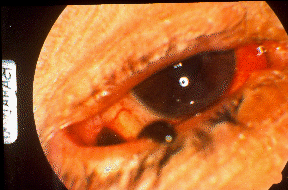 I have often shown the image at right in public presentations about leeches. If you look closely you can see a Dinobdella ferox peeking out from behind someone's
 lower upper eyelid and it's back sucker holding onto the eyeball itself (the eye is upside down). This was sent to Gene Burreson by a physician in India many years ago, and it never fails to first confuse, and then disgust, a lunch-time scientific audience!
The tribulations of people with leeches in their eyes continues. In regions of the world where the terrestrial leeches abound, like Australia and in the wet forests of Madagascar, leeches in the eyes and ears is all too common. Getting aquatic leeches in an eye, while less common, is perhaps more terrifying in light of the larger size of these "medicinal" leeches.
The Australian story is remarkable for this misperception: "Dr Fogg says tweezers were not an option as simply pulling the leech off could leave its head lodged in the eyeball, leading to infection." Even if leeches had a head, which they do not, for this to be true, the head would have to embed, which it does not since the leech would be unable to suck blood without the seal it makes with its oral sucker.
We might have Hollywood to blame for this. In The African Queen, Humphry Bogart's character Allnut (a Canadian, I might add), when he emerges from a swamp covered in leeches, declares to Rose (Katharine Hepburn), "No, no, don't touch 'em, don't! Salt, Rosie! ... You pull 'em off but their heads stay in! Poison the blood! Get the salt... If there's anything in the world I hate, it's leeches. Oooh, the filthy little devils."
If you do get a leech in your eye, salt water will get it out. It will have to be saltier than your tears, so it's likely to sting, and you'll want to flush your eyeball with water afterwards.
Every photograph of a leech in an eye is one where someone ran for a camera first instead of getting the thing out!
 I have often shown the image at right in public presentations about leeches. If you look closely you can see a Dinobdella ferox peeking out from behind someone's
 The tribulations of people with leeches in their eyes continues. In regions of the world where the terrestrial leeches abound, like Australia and in the wet forests of Madagascar, leeches in the eyes and ears is all too common. Getting aquatic leeches in an eye, while less common, is perhaps more terrifying in light of the larger size of these "medicinal" leeches.
The Australian story is remarkable for this misperception: "Dr Fogg says tweezers were not an option as simply pulling the leech off could leave its head lodged in the eyeball, leading to infection." Even if leeches had a head, which they do not, for this to be true, the head would have to embed, which it does not since the leech would be unable to suck blood without the seal it makes with its oral sucker.
We might have Hollywood to blame for this. In The African Queen, Humphry Bogart's character Allnut (a Canadian, I might add), when he emerges from a swamp covered in leeches, declares to Rose (Katharine Hepburn), "No, no, don't touch 'em, don't! Salt, Rosie! ... You pull 'em off but their heads stay in! Poison the blood! Get the salt... If there's anything in the world I hate, it's leeches. Oooh, the filthy little devils."
If you do get a leech in your eye, salt water will get it out. It will have to be saltier than your tears, so it's likely to sting, and you'll want to flush your eyeball with water afterwards.
Every photograph of a leech in an eye is one where someone ran for a camera first instead of getting the thing out!
Thursday, July 23, 2009
Marshal Brain - HowStuff(doesn't)Works
Marshall Brain, creator of HowStuffWorks (now a subsidiary of Discovery), which purports to be a clearing house of accurate technological information, badly mangles the truth about leeches in two podcasts: one on what is a medical [sic] leech and the other on how to remove a leech. In these uncited, apparently non-fact-checked articles (none of the leech biologists I know got a call), beyond the preposterous assertion that leeches look like slugs, Mr. Brain claims:
1) that leeches merely double in size when they feed (they can increase 5 times their weight or more).
2) that leeches raised in captivity are "sterile to a certain degree" (all leeches, wild or farm raised harbour Aeromonas in their crop; a course of antibiotics is recommended during post-operative leech therapy)
3) that they quickly attach and start feeding (far from true, especially in North America)
4) that leeches hold on with rows of tiny teeth (they hold on with their suckers, the teeth, far too small for holding onto anything, and which do not meet in any kind of bite, are used only for making incisions)
5) that removal of leeches requires one "to rip the teeth away from your skin" (in fact all that is needed is to gently break the suction seal made by the oral sucker at the smaller end of the leech, once that seal is broken, the leech cannot hold on and can be readily removed by detaching the posterior sucker)
6) that is will not hurt "because the leech has injected a numbing agent" (see my previous post about this unsubstantiated myth)
This is all timely in light of Carl Zimmer taking to task George Will and the Washington Post for failure to fact check on science. Alas, some science writers too fail to fact check. Please note that Discover Magazine where Carl is a columnist has no relationship with Discovery Communications where Brain blogs about "stuff", likemedical medicinal leeches.
1) that leeches merely double in size when they feed (they can increase 5 times their weight or more).
2) that leeches raised in captivity are "sterile to a certain degree" (all leeches, wild or farm raised harbour Aeromonas in their crop; a course of antibiotics is recommended during post-operative leech therapy)
3) that they quickly attach and start feeding (far from true, especially in North America)
4) that leeches hold on with rows of tiny teeth (they hold on with their suckers, the teeth, far too small for holding onto anything, and which do not meet in any kind of bite, are used only for making incisions)
5) that removal of leeches requires one "to rip the teeth away from your skin" (in fact all that is needed is to gently break the suction seal made by the oral sucker at the smaller end of the leech, once that seal is broken, the leech cannot hold on and can be readily removed by detaching the posterior sucker)
6) that is will not hurt "because the leech has injected a numbing agent" (see my previous post about this unsubstantiated myth)
This is all timely in light of Carl Zimmer taking to task George Will and the Washington Post for failure to fact check on science. Alas, some science writers too fail to fact check. Please note that Discover Magazine where Carl is a columnist has no relationship with Discovery Communications where Brain blogs about "stuff", like
Tuesday, July 14, 2009
Injury in Iowa - Leeches score another win.
 When Eric Poore looked at his finger, there wasn’t much left. Wedding ring smashed, skin, muscle and blood vessels stripped away... nothing but bare bone and the tendons holding the mangled mass together. Paramedics snipped off Eric’s gold wedding band and rushed him to the hospital. Fully four trauma centers declined to treat Poore’s poor finger until Greg Yanish rushed to fix it some hours later. Yanish describes the blood flow in a delicately reattached finger “like the drain in the bathtub is slow, but the faucet is on full blast”. Once more, leeches to the rescue! Application of several (prob. H. verbana) to the reconstructed finger both immediately and over several days and it looks like Eric Poore will get to keep his finger. (As an aside... my EMT friends remind me this is an excellent argument against titanium wedding bands... can’t be snipped off). Here's the full article from the Des Moines Register.
Thursday, April 2, 2009
The Rehabilitation of Princess Caraboo
 The sensational story of Princess Caraboo regards a young lady arriving in Almondsbury, England (just North of Bristol) in 1817, speaking a strange tongue and sporting various tattoos. When it was determined that she was a Princess of Javasu, kidnapped by pirates from her Indian Ocean home, she was taken in by the local dignitaries and feted for some 2 months as visiting royalty. Her scam was exposed in short order. There is no Island of Javasu. She was, in truth, one Mary Baker from Witheridge near Exeter, who, unable to find continued employment as a servant, had hit upon this rather novel method for achieving food and shelter. After being shipped off to the US by her duped, and now chastened, benefactors, the Worralls, Mary eventually returned to Bristol and by 1839 was more gainfully and respectably employed... selling leeches, of course.
Tuesday, January 27, 2009
Leech Barometer
 The notion that leeches can predict inclement weather achieved its zenith with the creation of the Tempest Prognosticator (at left) by Yorkshireman inventor George Merryweather, and which he put on display at the first World's Fair (the Great Exhibition at London's Crystal Palace in 1851). The idea seems to trace back to the (occasionally insane) William Cowper (1731-1800) who wrote
 "I have a leech in a bottle that foretells all these prodigies and convulsions of nature. Not... by articulate utterances ... but by a variety of gesticulations, which here I have not room to give an account of. Suffice it to say, that no change of weather surprises him, and that, in point of the earliest and most accurate intelligence, he is worth all the barometers in the world"
(letter to Lady Hesketh, 1789). Edward Jenner, to whom we owe the smallpox vaccine, was also an accomplished poet. In at least one (but not all) version of his Signs of Rain, the final lines read "The leech, disturbed, is newly risen/Quite to the summit of his prison."
Merryweather cited these lines as inspiration for his Tempest Prognosticator. The device required a leech in each of 12 jars. The glass was to be transparent so that the leeches could "see each other" and so agree amongst themselves as to their prognostication. If any leech climbed up and into the escape tube, its weight would dislodge a piece of whalebone, releasing a hammer that would ring the bell thus announcing the onset of inclement weather. The Great Exhibition's jury rendered no verdict on this, imaginative, device. Nor did the Admiralty or the Board of Trade show much interest in Merryweather's storm warning system. Who needs doppler radar anyway?
Thursday, January 22, 2009
Worst Science Jobs?
 The February 2009 issue of Popular Science magazine has listed a suite of 2009's worst jobs in science. Among them is Leech Researcher. Amusing and well-written article by Jason Daley. I must say though... I really think I've got the best job in the world (maybe next to Carl Zimmer).
Thursday, November 13, 2008
Leech Meeting in Washington DC
Friday November 14th,2008.
Waldo Schmitt Room
Natural History Museum
This event, gathering the country's leech biologists in one place, is becoming an annual affair as a premeeting to the Neurobiology meetings.
Morning session
8:45 am Welcome by Bill Moser and Otto Friesen
9:00 – 10:00 am Research talks John Hackett, moderator
Mark Siddall "Evolution of anticoagulation: Comparative salivary EST libraries from 3 leeches on 3 continents"
Eduardo Macagno "Application of MALDI imaging to study leech proteomics"
10:30 am – 12:00 pm Research talks (15’ each) Otto Friesen, moderator
Angela Wenning "News from our (leech) hearts"
John Hackett "Probing swim maintenance with drugs"
Peter Brodfuehrer "Swimming, glutamate and cell 204"
William Kristan"Leech decision-making"
Karen Mesce "Picking up the pace on what we know about the crawling motor pattern in the leech"
Afternoon Session
Posters
Waldo Schmitt Room
Natural History Museum
This event, gathering the country's leech biologists in one place, is becoming an annual affair as a premeeting to the Neurobiology meetings.
Morning session
8:45 am Welcome by Bill Moser and Otto Friesen
9:00 – 10:00 am Research talks John Hackett, moderator
Mark Siddall "Evolution of anticoagulation: Comparative salivary EST libraries from 3 leeches on 3 continents"
Eduardo Macagno "Application of MALDI imaging to study leech proteomics"
10:30 am – 12:00 pm Research talks (15’ each) Otto Friesen, moderator
Angela Wenning "News from our (leech) hearts"
John Hackett "Probing swim maintenance with drugs"
Peter Brodfuehrer "Swimming, glutamate and cell 204"
William Kristan"Leech decision-making"
Karen Mesce "Picking up the pace on what we know about the crawling motor pattern in the leech"
Afternoon Session
Posters
Subscribe to:
Posts (Atom)

 Posts
Posts


